

 Euro (EUR)
 USA (USD)
 AUD (AUD)
 CAD (CAD)
 UK (GBP)
 Chinese Yuan (CNY)
 Hong Kong Dollar (HKD)
 Swedish Krona (SEK)
 South African Rand (ZAR)
 Norwegian Krone (NOK)
 Israeli New Sheqel (ILS)
 Brazilian real (BRL)
 United Arab Emirates dirham (AED)
 Swiss franc (CHF)
Written by Maksim
The knives I choose to carry are completely handmade in Sanjo, Niigata and Sakai, Japan, and have been heavily tested by me personally before I decide to sell them. I do not sell any stock knives. All knives JNS carries are either designed by JNS together with the blacksmith, or finished in our own workshop — sharpened on Japanese horizontal wheels and finished with natural stones. Spine and choil are rounded and polished on all JNS made knives.
I am a chef and I use knives every day. I only carry knives I would use myself and be proud to give as a gift. If I try something and I do not like it — I do not sell it, simple as that.
About Carbon Steel
Almost all knives I carry are carbon steel. Many people are confused or scared away from carbon steel when they see rusty or discolored knives. But this is mostly a care problem, not a steel problem. Here is what you need to know:
- Carbon steel gets sharper than stainless and holds the edge longer. There is no argument about this — it is just chemistry.
- Carbon steel can rust if you leave it wet or in a humid environment. Wipe it dry after every use. That is all you need to do.
- Patina is not rust. A dark gray or brown patina that forms on the blade over time is normal and actually protects the steel. Do not try to remove it with chemicals.
- If you see orange spots — that is rust. Clean them off with a cork and some powder cleanser, or fine sandpaper. Then dry and oil the blade.
- Do not put carbon steel in the dishwasher. Ever.
- Carbon steel is much easier to sharpen than stainless, especially on natural stones. This is one of the big reasons why some professionals prefer it.
If you take care of your carbon steel knife it will last your entire life and more. Many of the best carbon knives I have used are 40–50 years old and still work perfectly.
Shigefusa
Mr. Tokifusa Iizuka and his two sons work every day in their small workshop in Sanjo to make their masterpieces. They only use one kind of steel — which has reached perfection over years of hard work. The forging, shaping, heat treatment and final sharpening and polishing are all done by hand, one by one.
As a finishing step they use Japanese natural stones to make their unique and beautiful kasumi finish. All this work produces knives — whether kurouchi or kasumi — that do not leave the shop until they have perfectly smooth lines and razor sharp edges.
Shigefusa knives are in my opinion some of the best kitchen knives in the world. The balance, the grind, the edge retention — everything is perfect. That is why they sell out immediately every time I get them.
Yoshiaki Fujiwara — "The Workhorse"
These knives are made by Mr. Kiyoshi Kato, born 1944 in Tokyo. He began swordsmith training in 1964 and is a licensed swordsmith. He uses his collection of very old Tamahagane steels for his sword masterpieces, and he entered knife making in 1977. His workshop is in Hokuto City, Yamanashi.
Mr. Kato uses a special quenching technique with charcoal and water that gives the steel extra hardness not often seen in regular clad knives. This makes his kitchen knives feel very similar to honyaki — incredibly stiff with almost no flex.
When I first received his prototype knives I was shocked — they were thick, almost deba-like, not what I expected at all !!! But then I used them and understood completely. By the end of testing everyone who tried them wanted to buy one. Any knife that cuts like a laser and refuses to chip deserves my support.
Toyama Noborikoi 昇鯉
Toyama Noborikoi 昇鯉 — made only for JNS
Syuuji Toyama is a great blacksmith from Sanjo, Niigata. All his knives are made entirely by himself — no help, no factory. The Noborikoi line (kanji on the back) is made exclusively for JNS with better fit and finish and his best heat-treatment and steel.
Toyama makes very good working knives. Not as much fame as Shigefusa, but in my experience they are excellent performers and much easier to find. Great value for the quality you get.
Munetoshi
Munetoshi — rustic, tough, amazing cutter
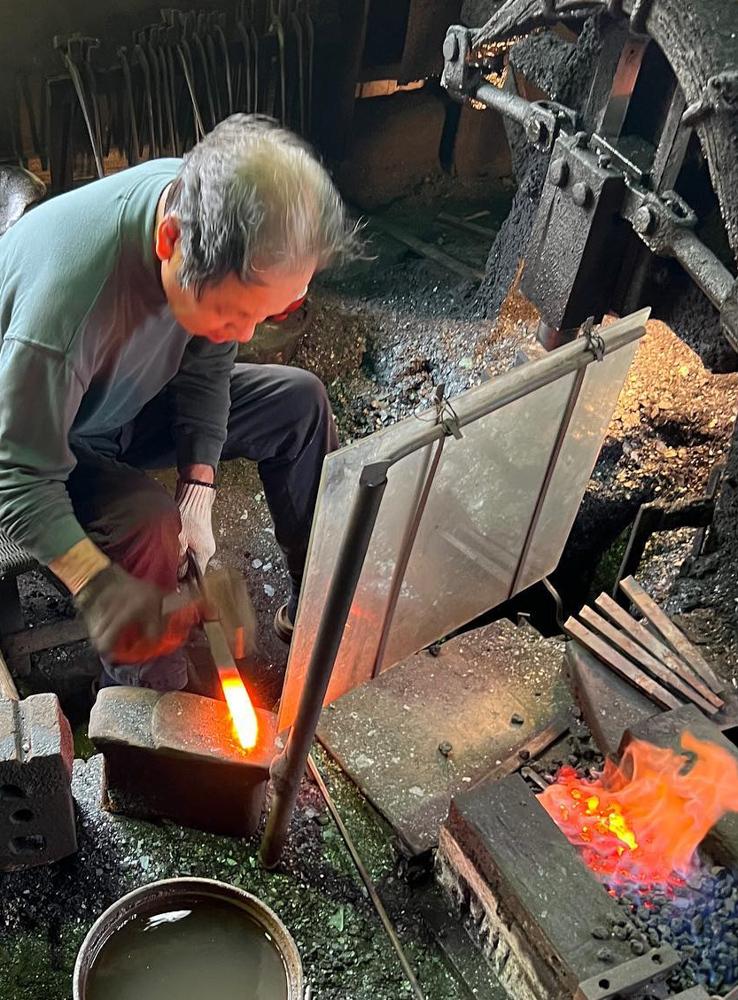
Third generation blacksmith. Kouiti Turumaki has been a blacksmith for over 50 years and learned everything from his father. He is specialized in white steel and heavy duty blades — axes, nata, and chopping tools. That is exactly why I first approached him for my butcher knife. They turned out outstandingly strong and very robust.
Fit and finish is not his thing — you cannot expect any on Munetoshi knives. But in my opinion that is not a bad thing at all. His knives are made for abuse and to be strong !!! He water quenches all his knives and the finish is rough and rustic.
In my opinion they are amazing cutters — on par with Shigefusa and Kato. Super easy to sharpen and you get an amazing edge with white steel. Much tougher than other white steel knives I have tried. At this price point they are very very hard to beat !!!
Wakui — Toshihiro Wakui
Wakui — classic Sanjo geometry, amazing forging
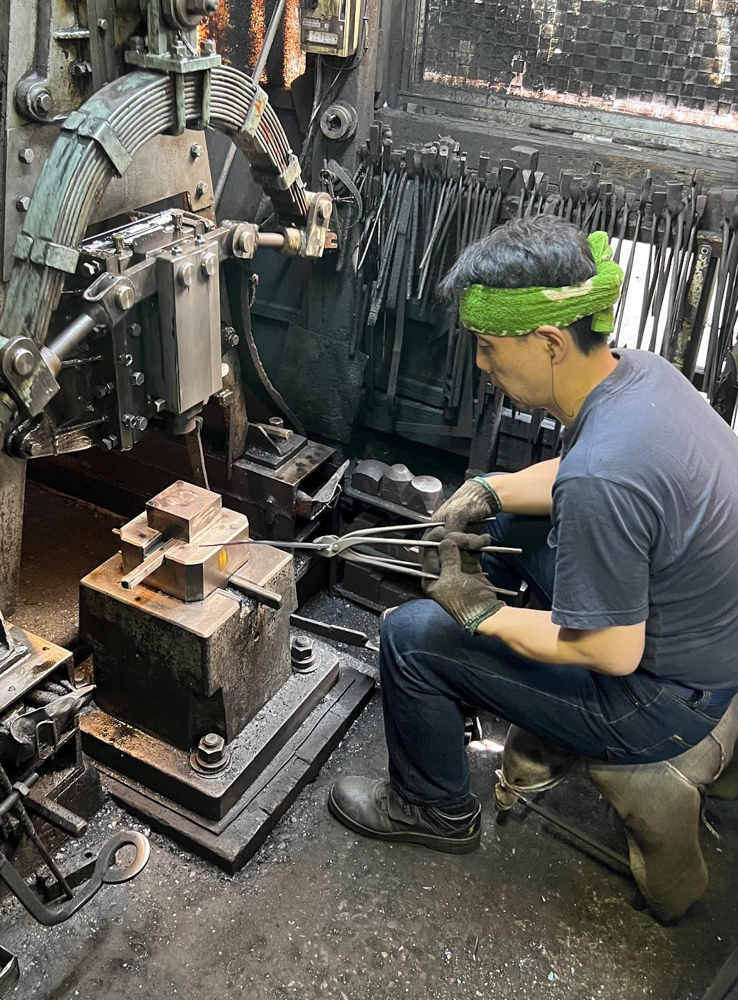
Toshihiro Wakui is a third generation blacksmith from Sanjo, Niigata. His family business was hand-forged crowbars — until demand for them dried up completely. Instead of giving up, he went to Kazuomi Yamamoto of Yoshikane and asked to learn knife making. For four years he did a full day at his own workshop and then went straight to Yoshikane to learn knife making in the evenings. That kind of dedication shows in the knives.
His background forging crowbars — tools that need to be extremely strong — carries through into the knives. Classic Sanjo geometry, strong spine, very good tapering from spine to choil.
The JNS x Wakui version is forged and heat treated by Wakui and then finished in our workshop — sharpened on vertical Japanese stones for an extra even bevel, uchigomori polish, spine and choil mirror polished. The Workhorse line was made with the same thickness specs as my first Kato prototype :) Amazing cutter and the forging on these makes them very easy to grind.
JNS Knives — Kokorozashi & Tamamoku
JNS Kokorozashi — sharpened and finished in our workshop
JNS house brands made in our own workshop. All knives are one of a kind and numbered. Sharpened on Japanese water wheels. The blank is forged by Kisuke Manaka, Tanaka Yoshikazu, Wakui and more.
Kokorozashi (志) means will, motivation, ambition, a sense of purpose. With this brand I push myself to make the grind as good as I can and the fit and finish as good as I can. All come with rounded and polished spine and choil, flat bevel as possible (still convex), and razor sharp out of the box.
Tamamoku (杢目) refers to the beautiful figuring pattern on the cladding. Sharpened on Japanese horizontal wheels and finished with natural stones.
Other Makers
|
Made in Sanjo, Niigata. One of the more popular Sanjo makers. Good quality and a step up from mass production without the price of the top makers. Great everyday working knives. Shop → |
Forged in Sakai with amazing heat treat. Finished by JNS with uchigomori. Super thin behind the edge — does things the heavier knives cannot. Very easy to sharpen on natural stones. Shop → |
|
JNS house brand, same maker as Kaeru but carbon steel. Kurouchi finish only. Extra thin grind with great Sanjo-style tapering. Shop → |
JNS house brand. SLD steel core with stainless cladding — very good edge retention with the easy care of stainless. A great first Japanese knife with no rust worries. Shop → |
Quick Care Tips
- Wipe dry after every use. Do not leave the blade wet or lying in a wet cloth.
- No dishwasher. Ever. Heat and detergent will destroy the steel and the handle.
- Oil if storing long term. A thin coat of camellia oil or food-safe mineral oil protects the blade.
- Patina is good. Let it form naturally. It protects the steel.
- Use a wooden or plastic cutting board. Glass and ceramic boards destroy all knives, not just Japanese ones.
- Sharpen on stones for best results. These knives are designed to be sharpened on stones — that is how you get the most from them.
That's it :) If you have questions about which knife is right for you, just message me on WhatsApp — I am happy to help.